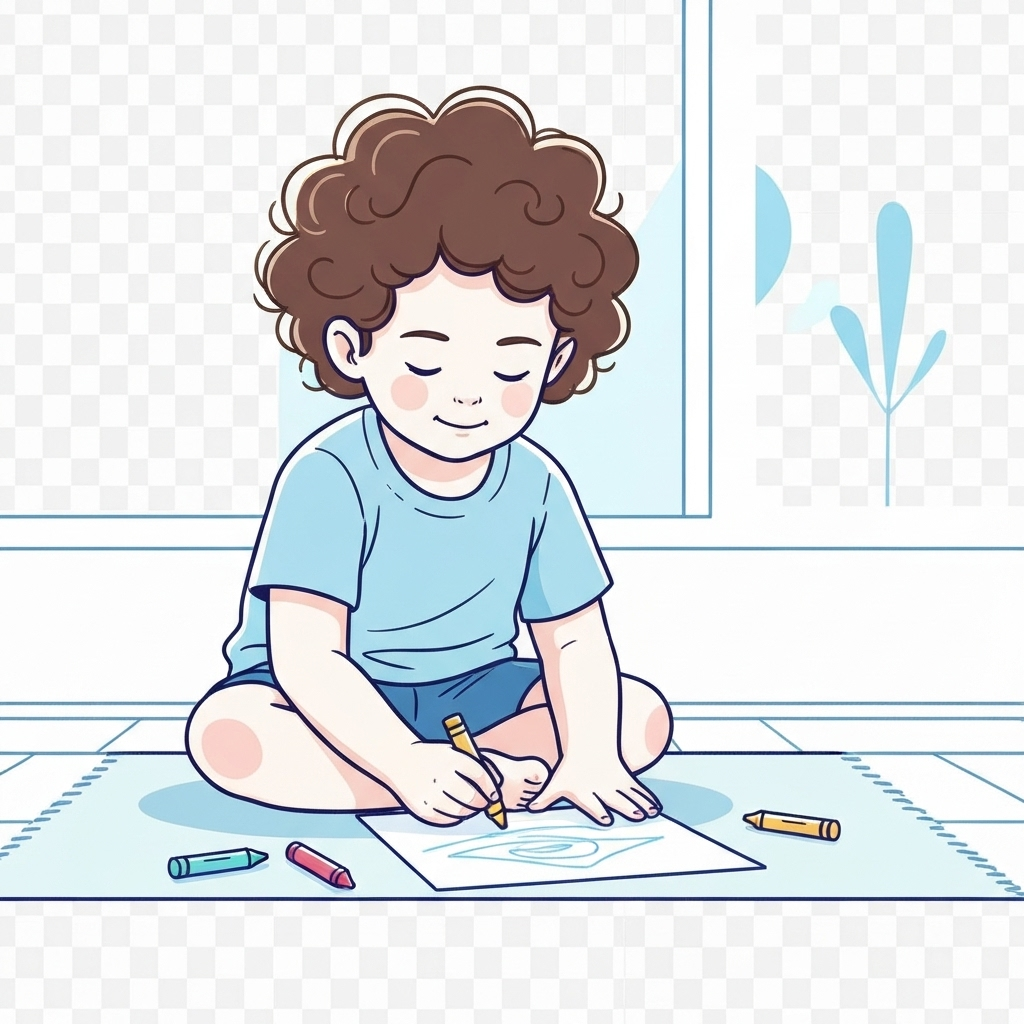
Letter Tracing: Helping Your Child Form Letters the Right Way
Letter formation habits are easy to build and hard to undo. A few simple things — start points, capitals first, and enough gross motor play — make an enormous difference.
Tracing looks like the simplest activity in early learning: here is a letter, follow the line. But how a child traces matters more than whether the result looks neat, because formation habits set quickly and are surprisingly hard to change later.
A child who has learned to draw a lowercase b as a line plus a separate circle will keep doing that for years, and it slows their writing down long after the letter looks fine.
Before the pencil: build the arm
Handwriting is a whole-arm skill before it is a finger skill. A child who cannot yet control their shoulder and elbow will compensate by gripping the pencil very tightly, which is tiring and produces shaky lines.
If your child's grip looks white-knuckled, spend a week or two on bigger movements before more tracing:
- Drawing on a vertical surface — a wall-mounted sheet, a steamy window, a blackboard
- Big shapes in the air with a whole arm
- Playdough, tearing paper, threading beads, squeezing pegs
- Tracing letters in a tray of sand, rice or flour
None of this looks like handwriting practice. All of it is.
Capitals first
Most teachers introduce capital letters before lowercase, and there is a practical reason: capitals are built from straight lines and simple curves, all starting at the top. L, T, E, F, H and I need no curves at all.
Lowercase letters demand more — closed loops, ascenders, descenders, and letters that start in the middle rather than the top. They are worth waiting for.
Start points are the whole game
The single most valuable thing you can teach is where each letter begins. Almost every letter starts at the top. Two common exceptions worth knowing are d and e.
Why it matters: a letter drawn from the correct start point in one continuous movement can eventually be written quickly and joined up. The same letter assembled from separate pieces cannot.
So when your child traces, watch their pencil rather than the page. If they are starting at the bottom, or lifting the pencil three times for one letter, gently show the movement again — then let them try. Describing the movement out loud helps: "down, and around".
Try it with L
Capital L is the right first letter. Two strokes, both from the top, and no curve.
- On a big sheet, or a steamy window, you go first. Start at the top. Say "down," then "across." They watch your hand, not a finished letter.
- Their turn, the same size. If the stick starts at the bottom, stop and show the start again. Do not talk about how tidy it looks.
- Three more L's, then stop. The next sitting can be T: the same down-stroke, with the line across the top instead of the bottom.
If the grip goes white on the first L, put the pencil down and make the L in the air with the whole arm. The page can wait.
What good tracing practice looks like
- Few letters, many repetitions. Five letters traced carefully beats twenty-six rushed. The alphabet in one sitting is far too much for a four-year-old.
- Large before small. Big letters use the arm; small letters demand fine control that comes later.
- Hollow outlines, then a blank line. Tracing builds the shape; writing it unaided is what proves it stuck. A practice line after the traced letters is where the real learning shows.
- Consecutive letters, not random ones. Working through the alphabet in order gives a sense of progress.
- Stop while it is still going well. Ending on success is what makes them willing next time.
Signs to slow down
- The grip tightens or the hand is shaken out repeatedly — fatigue, not laziness
- Letters get worse across the page rather than better
- Your child avoids the activity, or rushes to finish
- The pencil is pressed hard enough to tear or emboss the paper
Any of these mean the task is too long or too hard, not that more practice is needed.
A note on left-handed children
Left-handers cover what they have just written with their own hand, which makes copying and tracing genuinely harder. Angling the paper clockwise and sitting so their left side is unobstructed both help. Never move the pencil to the other hand.
Making practice pages
On the worksheet generator, pick letter tracing and one level. Ages 4–5 gives a short run of capital letters, about five, not the whole alphabet, then a blank line to try the letter without the outline. Ages 5–6 moves to lowercase, including letters that reach above and below the line. The theme only changes the pictures around the letters.
One skill on the page. How to sit through it is in how to do a worksheet with a 4-, 5-, or 6-year-old. How many of those pages belong in a day is in how many worksheets a preschooler should do. Capitals in the first year and lowercase in the next is the same split as LKG vs UKG.
Watch the pencil, not the page. Where the letter starts matters more than how tidy it ends up.
About KiddoWorks Team
Articles are signed KiddoWorks Team, the people who run the site. A person's name goes on a page only when that person wrote it. About KiddoWorks